
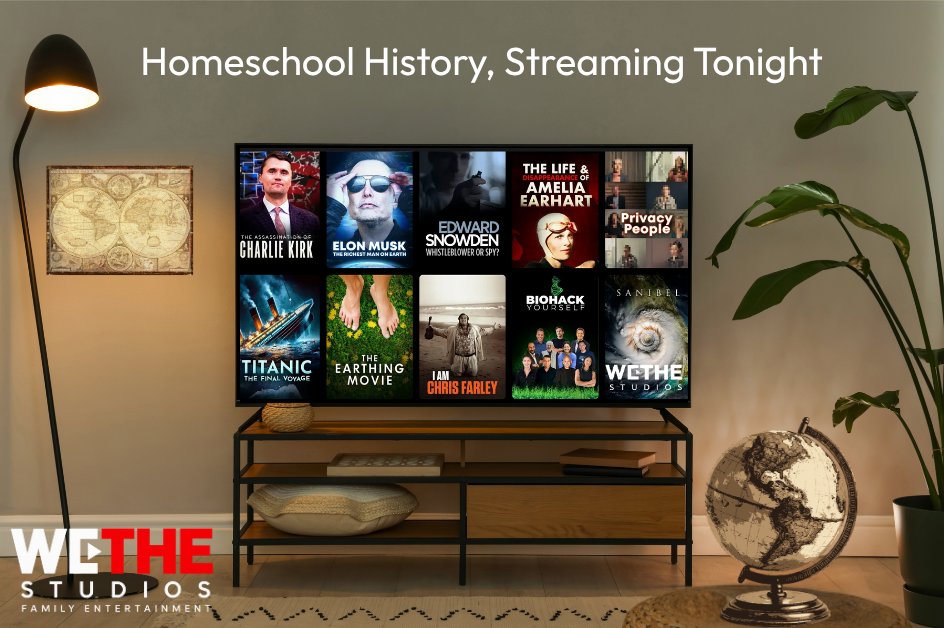
The best homeschool history documentaries tell one big story clearly, fit into a single sitting, and leave your kids with questions worth talking about. On We The Studios, three good places to start are Sinking of the Titanic: Minute by Minute, The Life & Disappearance of Amelia Earhart, and First Flights with Neil Armstrong. Each one pairs easily with free primary sources, so a show becomes a full history lesson.
If you homeschool, you already know the feeling. Some days the textbook wins. Other days, everyone (you included) needs the story to come alive a little. That is where a good documentary earns its spot on the lesson plan.
Quick Takeaways
- Short, focused documentaries work well as a lesson launch or a Friday wrap-up.
- Sinking of the Titanic: Minute by Minute, The Life & Disappearance of Amelia Earhart, and First Flights with Neil Armstrong are all in the WTS documentary library.
- These picks fit best for ages 8 and up, with a parent nearby for the heavier moments.
- Pair each one with free primary sources from places like the National Archives.
- Two or three discussion questions after viewing turn watching into learning.
Are homeschool history documentaries worth it?
Yes, when you use them on purpose. A documentary gives kids faces, places, and timelines that are hard to picture from a page, and it gives you a shared story to build the rest of the lesson around.
The key is to treat the film as a starting point, not the whole lesson. Watch together, pause when something big happens, and follow up with reading, writing, or a map. Kids remember more when they have to explain what they saw.
Our post on the new screen time study looks at why how kids watch can matter as much as how long.
Which history documentaries can you stream on WTS?

These three fit a homeschool history plan especially well, and two of them share an aviation theme, so they make an easy mini unit. None of them are a WTS Original. They are titles WTS has vetted and added to its library under the same content standards as the rest of the platform.
Sinking of the Titanic: Minute by Minute
This documentary walks through the Titanic disaster as it happened, focusing on the decisions and human stories in the ship’s final hours.
The Titanic struck an iceberg late on April 14, 1912, and sank early on April 15 during its first voyage, with some 1,500 of its roughly 2,200 passengers lost, according to Britannica.
Best for: ages 10 and up. Younger kids may find the loss of life hard, so preview it first.
Talk about it: Why did so many people believe the ship could not sink? Which choices that night would you have made differently?
The Life & Disappearance of Amelia Earhart
This film follows Earhart’s life as a daring pilot and the mystery of what happened to her. It works for both history and a little science, since kids can trace her route and talk about navigation in the 1930s.
According to the National Archives, Earhart and her navigator, Fred Noonan, vanished over the Pacific on July 2, 1937, during an attempt to fly around the world. The Archives shares records your kids can explore, including a radio log of her plane’s last messages and the U.S. Navy’s search report.
Best for: ages 9 and up.
Talk about it: What made Earhart brave? Why do people still search for answers almost 90 years later?
First Flights with Neil Armstrong
In this half-hour documentary series, Neil Armstrong interviews pilots and engineers, flies historic aircraft, and uses archival footage to show how flight developed, from early pioneer planes to helicopters and the first trips around the world.
The series first aired on A&E in 1991 and ran for three seasons and 39 episodes, according to Wikipedia. Armstrong was a research test pilot who flew the X-15 before he commanded Apollo 11 and became the first person to walk on the Moon on July 20, 1969, according to the University of Cincinnati’s Neil Armstrong archives. Those archives also share his 1949 flight log book, a fun primary source for kids.
Best for: ages 8 and up. The short episodes make it an easy fit for younger learners.
Talk about it: What problem did each new aircraft solve? Pair it with the Amelia Earhart film and ask: how did flying change between her time and Armstrong’s?
How do you turn a documentary into a homeschool history lesson?
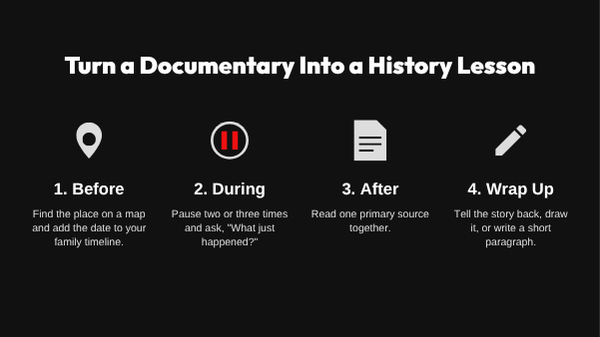
Plan a little before, a little during, and a little after. Ten minutes of prep can turn a single film or a half-hour episode into a full morning of learning.
Here is a simple rhythm that works for most ages:
- Before: Find the place on a map and add the date to your family timeline.
- During: Pause two or three times and ask, “What just happened?” This is especially important for the younger children who have a shorter attention span. With many documentaries including black and white scenes from the past, it’s helpful to have a parent or adult help keep them engaged by talking about the facts as you go. Have older kids jot down one fact per pause.
- After: Read one primary source together, like a National Archives record on Earhart.
- Wrap up: Have each child tell the story back (best for younger children), draw it, or write a short paragraph. Depending on what the documentary is about, you can have your child pretend to be the person it was about. What would they do differently? How might they feel?
Our family movie night checklist has more questions to ask before you press play, and many of them work just as well on a school day.
What age are history documentaries right for?
Most history documentaries fit kids ages 8 and up best, but your child’s maturity matters more than the number. Real history includes loss and war, and some kids feel that deeply.
Preview anything with heavy themes, and stay in the room for the first viewing. If you have tweens, our guide on what to watch with tweens shares tips for matching shows to their interests and your family’s standards.
How WTS fits into your homeschool week
WTS is built for families who want to know what they are pressing play on. Every title, whether it is a WTS Original or a licensed movie or show, follows the same content standards: no profanity, no sexual content, and no glorifying alcohol.
That means you can spend your prep time on the lesson, not on screening for surprises. WTS is also adding more educational and homeschool-friendly programming, so this collection is just the beginning.
Frequently Asked Questions
What makes a documentary good for homeschool history?
A good homeschool documentary tells one clear story, uses real footage, photos, or records, and stays focused enough to finish in one sitting. It should also leave room for questions. If your kids want to look something up afterward, the documentary did its job.
Can documentaries replace a history curriculum?
Documentaries work best alongside a curriculum, not in place of one. They build interest and help kids picture people and places. Reading, writing, timelines, and primary sources do the deeper work. Many homeschool families use a documentary to open a unit or review it at the end.
How often should we use documentaries in homeschool?
There is no set rule, but once a week is a comfortable rhythm for many families. Treat it like a field trip at home: something special that anchors a topic. We call these “In-home field trips” in our house and really hype our kids up. I try to make the entire day revolve around the theme of the documentary. For example, if we were to watch Sinking of the Titanic: Minute by Minute, I’d plan the entire day around it. For example, we may read a picture book in the morning, have an “iceberg” snack (coconut popsicle), watch the documentary, build our own ship out of pillows, blankets, and other items around the house, and then act out what happened. We would also incorporate a STEM activity to see who could create a boat that floats using household materials. Pairing each viewing with a short follow-up activity creates an opportunity for the learning to sticknbeyond the screen.
Where can kids find primary sources to go with a documentary?
The National Archives and the Library of Congress both share free digital records, photos, and letters. For the Amelia Earhart film, the National Archives posts her letter to President Franklin D. Roosevelt and the Navy’s 1937 search report. Pick one short source and read it together.
How do I handle sad or scary parts of real history with kids?
Preview first, then watch together and pause when needed. Name what happened in simple, honest words and ask how your child feels. It helps to point out the helpers, the lessons learned, and how people changed things afterward. Younger kids may do better with a shorter clip.
Start Your Next History Lesson Tonight
History is full of real stories that kids will remember for years. Pick one documentary, grab a map, and see where the questions lead.
Start streaming at wethestudios.com and find these titles in the WTS documentary library.
Leave a Reply